Mostrando entradas con la etiqueta instal.lació. Mostrar todas las entradas
Mostrando entradas con la etiqueta instal.lació. Mostrar todas las entradas
Ujino Muneteru
Ujino Muneteru turns mechanical sounds into complex rhythms. For Art Forum 2010, Ujino Muneteru has reconstructed his sound sculpture Plywood City, which he first created in 2008 for his solo exhibition Crossband at PSM, Berlin.
On the opening day of Art Forum Berlin, VernissageTV met with Sabine Schmidt (Director, PSM Berlin) who provides us with an introduction to the work of Ujino Muneteru.
"Bored by the technical limits of conventional instruments, Ujino, a guitarist and bassist himself, experiments with new sounds. Different resonant bodies widen the spectrum of timbre; the sound of simple mechanical motors is used to produce new tones. In particular domestic appliances, tools, and large machinery from the fifties to the seventies are employed for their mechanical simplicity and physicality. Japanese Noise Music, a sound movement from the eighties, influenced by John Cage and the Fluxus movement, is referenced in Ujino's productions.
The title of the sound sculpture now presented at the Art Forum Berlin refers to a part of Tokyo, which is built form wood and is colloquially known as Plywood City. Ujino has constructed a wooden model ciy, which is animated by kinetic objects and sound. The basis of Plywood City is formed with art transport crates.
Ujino Muneteru 宇治野宗輝 (born in 1964) lives and works in Tokyo. He earned his B.A. in craft from Tokyo National University of Fine Arts and Music in 1988. He has exhibited internationally in institutions such as the Mori Art Museum, Tokyo; House of World Cultures, Berlin; ZKM, Karlsruhe; 15th Biennale of Sydney; Barbican Gallery, London; and many others. Ujino Muneteru's solo exhibitions include Yamamoto Gendai, Tokyo (2011); Ujino and the Rotators, Hayward Project Space, London (2009); and Crossband, PSM, Berlin (2008).
Ujino Muneteru: Plywood City / PSM Berlin / Art Forum Berlin. Interview with PSM Director Sabine Schmidt, October 6, 2010.

The Resonance Project
Resonance is a sound sculpture that fuses technology and ancient, organic vessels. Speakers are crafted from the resonant bodies of gourds and a software audio instrument - modeled on living systems - captures, processes and plays ambient soundscapes. Used as vessels since ancient times and throughout countless cultures today as musical instrument resonators, gourds are used in this installation as vessels to carry the sound of people.
Paul DeMarinis - The Messenger, Internet Based Installation
1998/ Revised 2005
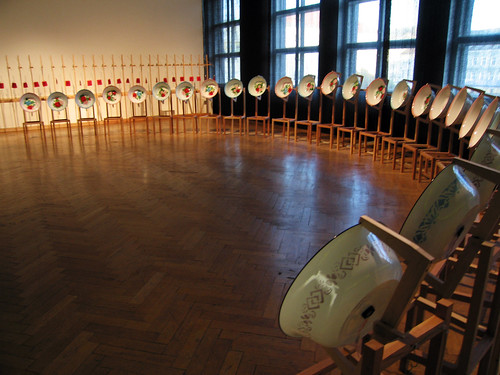
The Messenger is an Internet driven installation based on early proposals for the electrical telegraph, in particular those made by the Catalan scientist Francesc Salvá. It examines the metaphors encoded within technology, especially lost or orphaned technologies and tries to trace their origins, speculating on the way that mechanisms are the repositories of larger unspoken conceptions and dreams. It takes the telegraph as a point of departure from which to examine the relationship between electricity and democracy, and how electrical telecommunication technologies have participated in our solidarity and in our isolation, in our equality and our oppression, in the richness of our experience and the uncertainty of our lives. Email messages sent from around the world are received by a computer and spelled out, one letter at a time over three fanciful telegraph receivers: a circular array of 26 talking chamber pots speaks out the letters in 26 different voices. Men, women, schoolchildren and aged pensioners are jarred into vocalization when their individual letter is activated. The watery resonance of the metal bowls creates a unique reverb for each voice, disconnecting it from the other voices and from the acoustic space of the gallery.
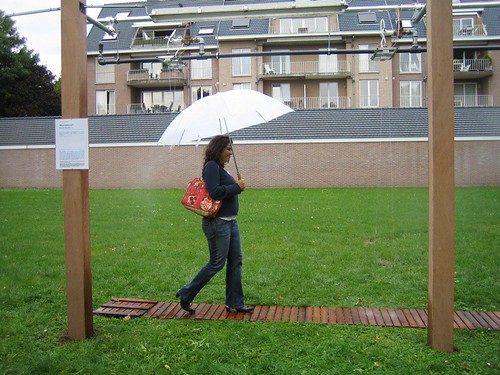
Rain Dance, Paul DeMARINIS
Play Music with rain and an umbrella

Antonio De Luca / Mario Ciccioli
Imbutofono
Suonare luoghi /
Performance nella Cappella di San Vito / salento 2003
Imbutofono track 2 April 24, 2008Suonare luoghi
Antonio de luca / Mauro Tre
Frammento della performance alla Fondazione Pistoletto
Biella Settembre 2008
Frammento della performance alla Fondazione Pistoletto
Biella Settembre 2008
November 27, 2009
Video realizzato da RaiSat1 ARTE nel 1998.
Intervista a Mario Ciccioli nel suo studio a Tuscania condotta da Alessandra Crisanti dove l'artista spiega la genesi del proprio lavoro riguardo la costruzione e l'installazione di Arpe Eolie.
Installazione di tre Arpe Eolie, realizzata a Ginevra nel 1989 davanti al "Musee d'Histoire des Science" nel Parco "Perle du Lac".
September 04, 2009
Tabakalera présente plusieurs œuvres de douze artistes qui travaillent à partir du son. Par des installations sonores, des sculptures ou des travaux audiovisuels interactifs, l'exposition propose une nouvelle manière de découvrir Tabakalera par le son. Des œuvres spécifiquement créées pour l'exposition conversent avec d'autres qui se sont adaptées aux imposants espaces du bâtiment. C'est pourquoi, et dans ce but, nous avons créé un parcours guidé dans le son qui tout en composant une exposition consacrée à l'art sonore nous invite à connaître un bâtiment emblématique comme Tabakalera.
Installation sonore interactive/Interactive sound installation
Voir plus/View more www.bechardhudon.com
Voir plus/View more www.bechardhudon.com
Antonio De Luca
May 13, 2009
Scultura sonora per ferro e ottone
Antonio De Luca e Mario Ciccioli
Installazione sonora permanente per acqua e aria
OSSERVATORIO NOMADE /SALENTO
Cappella di San Vito
Masseria torcito
MARZO 2003
Antonio De Luca e Mario Ciccioli
Cappella di San Vito, masseria Torcito ,
Salento - Marzo 2003
immagini di Giorgio D'ambrosio
Installazione sonora per ferro, piombo, acqua e cotone
- Palazzo Belmonte-Riso /
Palermo
Osservatorionomade
Antonio De Luca / Mario Ciccioli
Performance ed installazioni sonore nel Salento
Stanza dei suoni delle mani / Parte 2
Suzuki
Suzuki, Akio. akiosuzuki.com
http://www.arika.org.uk/resonant-spaces/akio-suzuki/
(escolta'l) i http://www.last.fm/music/Akio+Suzuki
Perhaps the most charming, engaging artist I’ve seen, Japanese musician and inventor, instrument builder and shaman Akio Suzuki is probably unknown to most of you. But we think his work is utterly captivating and crucial; it deserves a much bigger audience. Akio has been performing, teaching and building instruments for nearly 40 years. His music is simple and pure, and beautifully unworried by the rules of modern music. He explores nature and how its atmospheres and sounds can be harnessed and then set free, how you can lose yourself in the sound that surrounds us, and how musical creation and beauty exist in all things, in all moments.
“I think of Akio Suzuki as a kind of magician”
David Toop
“Hearing this music, I remember many things, including playing in a puddle as a tiny kid”
Yamatsuka Eye: Boredoms

 Akio Suzuki is known as a pioneer of sound art, but the breadth of his activities and the form of his works far exceeds the normal boundaries of sound art. It is perhaps more as a "quester after sound and space" that he has received the most attention from artists in many fields.
Suzuki's journey as an artist began in 1963 with a performance at Nagoya station, in which he threw a bucket full of junk down a staircase. The inspiration behind this performance - the idea that if one were to hurl an object down a well-balanced stairway, a pleasant rhythm might be the result - took the desire to "listen" as its subject. That desire to hear, to listen has remained the one constant in Suzuki's stance as an artist.
During the sixties, Suzuki's sense of playfulness led him to undertake a series of Self-Study Events, where he explored the processes of "throwing" and "following", taking the natural world as his collaborator. The experiences he gained in these events led him in the seventies to invent an echo instrument he named Analapos. The instrument's structure resembles that of two mirrors facing each other, reflecting into infinity. As an extension of the principles underlying Analapos, Suzuki constructed the Hinatabokko no kukan (Space in the Sun) in 1988. This space consists of two huge parallel walls, in between which the artist can sit all day and purify his hearing by listening to the reflected sounds of nature. This space leads the artist to discover a new method of listening. Suzuki himself comments, "Sound, which had been conceptually imprisoned in various spaces, is freed to circle the world."
 From the late seventies and through the eighties, Suzuki also developed a form of performance he refers to as Conceptual Soundwork. Applying a number of self-imposed, simple and austere rules, he uses objects close at hand in a mode of "intellectual play". While these events do on the one hand express a critique of meaningless improvised performance, at the same time Suzuki is constantly aware of the audience's process of listening and he attempts to create contemporaneous connections with the site of performance. It was around this time that Suzuki began to travel frequently to the US and Europe, and his performances at leading music festivals, Festival d'Automne (Paris, 1978) and Documenta 8 (Kassel, 1987) were rapturously received.
As sound art enjoyed a period of prosperity in the nineties, Suzuki was given the chance to create many installations, particularly in Berlin. Worthy of special note were his soundless installations, such as Otodate (Echo point, 1996) in Berlin, Enghien-les-Bains (since 1997, http://www.insitu-enghien.org/) and Strasbourg; Hana (Flower, 1997) at the Stadtgalarie Saarbrucken; and Pyramid (1999) which involved people excavating sounds. These soundless pieces were not designed to critique the old perceptual theories of music, rather they questioned the very location of music. Through their encounter with these works, the past experiences and memories of viewers were reconstructed as new experiences. This process was fundamental to the action of "listening" to the works.
 In recent years, the insights he gained from the Turbridge (1999-2000) installation at the Daad Gallery in Berlin have opened up new avenues of development for his future work. By recording and creating sound sources himself, and by using electric amplification with Suzuki's own self-designed output devices, he was able to reconstruct sounds and experiment with listening to the "factors of place". These experiments were followed up by the sound-drawing Mowe (Seagull, 2002) for the Berlin radio station SFB, and Nagekake & Tadori (Throwing and Following, 2002) which included some suggestions towards the construction of place. Visitors to the latter were able to experience a "place established by the artist as a wholly different space and time axis."
To run simultaneously with these experiments, Suzuki has started the Mogari series since 2002 at the Brunei Gallery at the School of Oriental & African Studies in London. This series centres around unbelievably powerful performances on iwabue - ancient and naturally-sculpted stone flutes which have been handed down in Suzuki's family. Using these ancient instruments Suzuki sculpts time and place, and through their music he searches for his own end.
http://www.arika.org.uk/resonant-spaces/akio-suzuki/
(escolta'l) i http://www.last.fm/music/Akio+Suzuki

Perhaps the most charming, engaging artist I’ve seen, Japanese musician and inventor, instrument builder and shaman Akio Suzuki is probably unknown to most of you. But we think his work is utterly captivating and crucial; it deserves a much bigger audience. Akio has been performing, teaching and building instruments for nearly 40 years. His music is simple and pure, and beautifully unworried by the rules of modern music. He explores nature and how its atmospheres and sounds can be harnessed and then set free, how you can lose yourself in the sound that surrounds us, and how musical creation and beauty exist in all things, in all moments.
“I think of Akio Suzuki as a kind of magician”
David Toop
“Hearing this music, I remember many things, including playing in a puddle as a tiny kid”
Yamatsuka Eye: Boredoms
Listen here
| http://www.arika.org.uk/resonant-spaces/x_flash/stone-flute.htm | |||||||||
| http://www.arika.org.uk/resonant-spaces/x_flash/analopos.htm |
PROFILE
Akio Suzuki is known as a pioneer of sound art, but the breadth of his activities and the form of his works far exceeds the normal boundaries of sound art. It is perhaps more as a "quester after sound and space" that he has received the most attention from artists in many fields. Suzuki's journey as an artist began in 1963 with a performance at Nagoya station, in which he threw a bucket full of junk down a staircase. The inspiration behind this performance - the idea that if one were to hurl an object down a well-balanced stairway, a pleasant rhythm might be the result - took the desire to "listen" as its subject. That desire to hear, to listen has remained the one constant in Suzuki's stance as an artist.
During the sixties, Suzuki's sense of playfulness led him to undertake a series of Self-Study Events, where he explored the processes of "throwing" and "following", taking the natural world as his collaborator. The experiences he gained in these events led him in the seventies to invent an echo instrument he named Analapos. The instrument's structure resembles that of two mirrors facing each other, reflecting into infinity. As an extension of the principles underlying Analapos, Suzuki constructed the Hinatabokko no kukan (Space in the Sun) in 1988. This space consists of two huge parallel walls, in between which the artist can sit all day and purify his hearing by listening to the reflected sounds of nature. This space leads the artist to discover a new method of listening. Suzuki himself comments, "Sound, which had been conceptually imprisoned in various spaces, is freed to circle the world."
From the late seventies and through the eighties, Suzuki also developed a form of performance he refers to as Conceptual Soundwork. Applying a number of self-imposed, simple and austere rules, he uses objects close at hand in a mode of "intellectual play". While these events do on the one hand express a critique of meaningless improvised performance, at the same time Suzuki is constantly aware of the audience's process of listening and he attempts to create contemporaneous connections with the site of performance. It was around this time that Suzuki began to travel frequently to the US and Europe, and his performances at leading music festivals, Festival d'Automne (Paris, 1978) and Documenta 8 (Kassel, 1987) were rapturously received. As sound art enjoyed a period of prosperity in the nineties, Suzuki was given the chance to create many installations, particularly in Berlin. Worthy of special note were his soundless installations, such as Otodate (Echo point, 1996) in Berlin, Enghien-les-Bains (since 1997, http://www.insitu-enghien.org/) and Strasbourg; Hana (Flower, 1997) at the Stadtgalarie Saarbrucken; and Pyramid (1999) which involved people excavating sounds. These soundless pieces were not designed to critique the old perceptual theories of music, rather they questioned the very location of music. Through their encounter with these works, the past experiences and memories of viewers were reconstructed as new experiences. This process was fundamental to the action of "listening" to the works.
In recent years, the insights he gained from the Turbridge (1999-2000) installation at the Daad Gallery in Berlin have opened up new avenues of development for his future work. By recording and creating sound sources himself, and by using electric amplification with Suzuki's own self-designed output devices, he was able to reconstruct sounds and experiment with listening to the "factors of place". These experiments were followed up by the sound-drawing Mowe (Seagull, 2002) for the Berlin radio station SFB, and Nagekake & Tadori (Throwing and Following, 2002) which included some suggestions towards the construction of place. Visitors to the latter were able to experience a "place established by the artist as a wholly different space and time axis." To run simultaneously with these experiments, Suzuki has started the Mogari series since 2002 at the Brunei Gallery at the School of Oriental & African Studies in London. This series centres around unbelievably powerful performances on iwabue - ancient and naturally-sculpted stone flutes which have been handed down in Suzuki's family. Using these ancient instruments Suzuki sculpts time and place, and through their music he searches for his own end.
per ordenar
Sculture Sonore - scultura sonora - Stormo Sonoro di Lucia Balzano -Olbia-
www.luciabalzano.com
Symphony for 54 Shoes (Distant Echoes) - Ingrid Bachmann
| November 12, 2007
Ingrid Bachmann's kinetic art installation was first presented in Regina, Saskatchewan, Canada. For Bachmann the piece is an exploration of tender or pathetic technology, for ends that are not necessarily considered productive.
Latest version was shown November 13 to December 14, 2008, at La Galerie des arts visuels, Université Laval, Quebec City.
Video: Wojtek Gwiazda
Websites:
http://www.arv.ulaval.ca/galerie/ingr...
http://www.molior.ca
http://www.ingridbachmann.com
From the Galerie des arts visuels website:
"L'œuvre habite ainsi l'espace tant par sa présence physique que sonore et évoque certes une présence humaine, personnages évoqués, anonymes qui nous proposent leur chorégraphie étrange et antispectaculaire."
Direction de la Galerie - Lisanne Nadeau
From Bachmann's website:
"This project continues my exploration of non-screen based computer technology to create works that interact with, confront and/or incorporate the physical world. I try to bring the complexity of the real world and experience into the digital experience, to complicate the relations between the virtual and material realms, to create works that situate themselves in the world in rich sensory, tactile and sonic ways."
Andrea Carson "View on Canadian Art" October 30, 2007:
http://viewoncanadianart.com/2007/10/...
"Symphony for 54 Shoes (Distant Echoes) ... echoes a tradition of 'ghost' works by artists including sculptor Rachel Whiteread, Christian Boltanski and Polish theatre & installation artist Jozef Szajna."
Other websites:
Bachmann's hermit website: http://www.digitalhermit.ca/
Turbulence project - New Radio and Performing Arts, Inc. website: http://transition.turbulence.org/netw...
Centre for Contemporary Canadian Art website:
http://www.ccca.ca/artists/artist_inf...
Latest version was shown November 13 to December 14, 2008, at La Galerie des arts visuels, Université Laval, Quebec City.
Video: Wojtek Gwiazda
Websites:
http://www.arv.ulaval.ca/galerie/ingr...
http://www.molior.ca
http://www.ingridbachmann.com
From the Galerie des arts visuels website:
"L'œuvre habite ainsi l'espace tant par sa présence physique que sonore et évoque certes une présence humaine, personnages évoqués, anonymes qui nous proposent leur chorégraphie étrange et antispectaculaire."
Direction de la Galerie - Lisanne Nadeau
From Bachmann's website:
"This project continues my exploration of non-screen based computer technology to create works that interact with, confront and/or incorporate the physical world. I try to bring the complexity of the real world and experience into the digital experience, to complicate the relations between the virtual and material realms, to create works that situate themselves in the world in rich sensory, tactile and sonic ways."
Andrea Carson "View on Canadian Art" October 30, 2007:
http://viewoncanadianart.com/2007/10/...
"Symphony for 54 Shoes (Distant Echoes) ... echoes a tradition of 'ghost' works by artists including sculptor Rachel Whiteread, Christian Boltanski and Polish theatre & installation artist Jozef Szajna."
Other websites:
Bachmann's hermit website: http://www.digitalhermit.ca/
Turbulence project - New Radio and Performing Arts, Inc. website: http://transition.turbulence.org/netw...
Centre for Contemporary Canadian Art website:
http://www.ccca.ca/artists/artist_inf...
Ellen Fullman
http://www.ellenfullman.com
Ellen Fullman performance at Berkeley Art Museum, December 4, 2009. With Ther...
Ellen Fullman performance at Berkeley Art Museum, December 4, 2009. With Ther...
interactuables
interactuables
Woodwater instruments, final edit
Piano stairs - TheFunTheory.com
Water Piano
Woodwater instruments, final edit
Piano stairs - TheFunTheory.com
Water Piano
instal.lacions
Gordon Monahan - Aeolian Winds Over Claybank Saskatchewan
Gordon Monahan - Spontaneously Harmonious in Certain Kinds
Tom Milnes- Sound Structure
Gordon Monahan - Spontaneously Harmonious in Certain Kinds
Tom Milnes- Sound Structure
Suscribirse a:
Entradas (Atom)